Data centre backup power: UPS step load, harmonics and 10 kV connection
A data centre usually has N+1 generation already, so a mobile unit appears in only four situations: generator failure, fuel contamination, capacity during an expansion, or a bypass while a fixed set is serviced. Each has different requirements, but all of them come down to one question — can the unit hold a UPS load that steps from nothing to full in a tenth of a second?
Short answer: 1 MW of IT load at PUE 1.4 means about 1.4 MW total, so the vehicle is 1,600–2,000 kW — either two 1,000 kW units in parallel or one 2,000 kW medium-voltage unit. Total kW is not the constraint; the step load is. A rectifier front end can jump from 0 to 80–100%, so size the set at 1.4–1.6× the UPS rating unless the UPS has a generator mode (walk-in) with a controlled ramp.
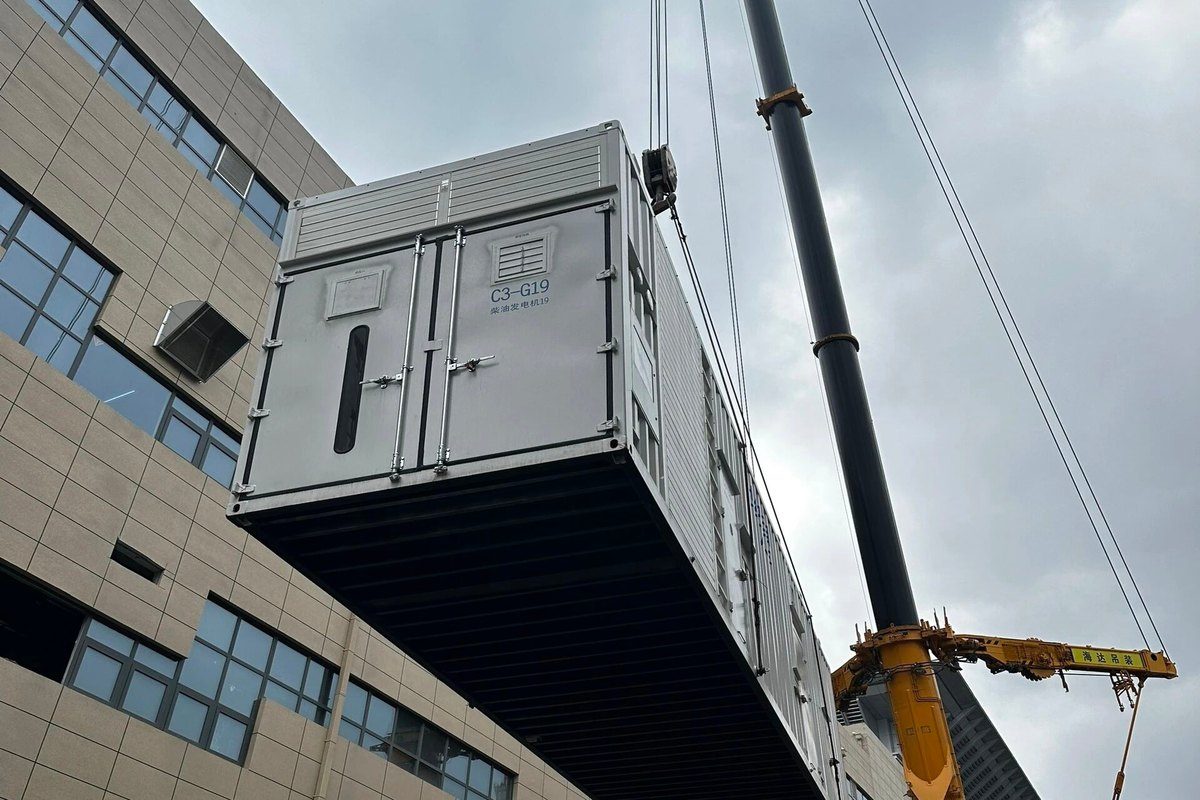
The step load is the real selection criterion
Ordinary load arrives gradually. A UPS does not. When mains fails, the UPS transfers to battery, the rectifiers reload, and the generator can see the load jump from 0 to 80% inside 100 ms. A synchronous machine rides that on excitation response and rotor inertia. Too small a set means voltage collapse and frequency dip; the UPS then rejects its input and transfers to bypass or shuts down — worse than an outage, because bypass exposes the load directly to mains.
| UPS rating | Rectifier load | Set without ramp | Set with walk-in |
|---|---|---|---|
| 400 kVA | ~360 kW | 500–630 kW | 400–500 kW |
| 800 kVA | ~720 kW | 1,000–1,250 kW | 800–1,000 kW |
| 1,200 kVA | ~1,080 kW | 1,600–2,000 kW | 1,250–1,600 kW |
| 2 × 800 kVA parallel | ~1,440 kW | 2 × 1,000 kW | 2 × 800 kW |
Ranges are engineering experience, not guarantees. Check the UPS manufacturer's generator compatibility table: some ramp at 25%/s by default, some accept a 0→100% step, and some advise against generator operation entirely. Getting this wrong makes an oversized set useless.
Harmonics and derating
Six-pulse rectifiers commonly produce 25–30% THDi; twelve-pulse 8–10%; modular UPS with active PFC can reach 5%. A generator tolerates far less harmonic current than a transformer, because the additional copper and iron losses appear in the stator and exciter windings and can only leave through the set's own fan.
- THDi above 20%: derate to 0.85. Above 30%: 0.70–0.75. Deduct this at selection, not at commissioning.
- Specify PMG excitation or an AREP auxiliary winding — better non-linear load capability and better short-circuit support.
- Filters consume capacity too. Passive filters absorb reactive power and active filters need a supply; neither is free.
- A Δ–Y isolation transformer traps triplen harmonics — check its vector group before buying filters.
10 kV connection: the cable is the least of the savings
| Connection | Cable at 1,000 kW | Volt drop per 100 m | Site requirement |
|---|---|---|---|
| 0.4 kV LV | 4 × (3 × 240) mm² Cu, ~3.2 t per 100 m | 3–4% | Spare LV breaker; drum needs craning |
| 10 kV MV | 3 × 95 mm² Cu, ~0.3 t per 100 m | <0.5% | Spare ring-main way and protection settings |
Three actions must be completed before energising an MV connection:
- Phase check. Sequence meter plus phase comparator, measured on both sides. A data centre busbar carries UPS and chillers, and a phase error is measured in hours of downtime.
- Protection coordination. The vehicle feeder must ride through UPS starting current and still grade with upstream protection. Wrong settings either prevent energisation or trip the whole campus.
- Anti-islanding and back-feed protection. Mechanical interlock, electrical interlock and reverse-power protection. Data centre operators check this harder than anyone.
The chiller plant is the under-estimated single load
PUE 1.4 means roughly 400 kW of cooling behind 1 MW of IT, and chillers dominate it. Do not simply add the kW: check the largest single motor starting with everything else at full load. A centrifugal chiller draws 2–3× rated current on a soft starter and 1.1× on a VFD, but the start lasts 10–30 seconds — exactly when the UPS is also stepping.
A common and cheap fix: let the UPS carry IT load immediately, delay the chiller plant by 30–60 seconds in the BMS so the two transients do not coincide. That logic is worth more than one frame size of generator.
Space, exhaust and noise
- Floor loading. A 2,000 kW container set can weigh 12–15 t in running order; roof installation needs a structural check and a lifting route.
- Exhaust must not reach fresh-air intakes. Keep separation from precision-cooling intakes and cooling towers, or the filters blacken within a week.
- Fuel for 8–24 hours. Campus fire rules cap stored fuel; an on-board tank is an advantage because it does not consume the site's storage allowance.
- Noise at the boundary is usually 55 dB(A) at night, stricter near housing. MV units are large — do not delete the acoustic canopy and silencers to save weight.
Questions data centre teams ask
We have N+1 generators — why a vehicle?
Because N+1 fails together: generator breakdown, contaminated fuel, control-network loss, cooling water failure. The vehicle is an independent source that shares no fuel path, control system or safety boundary with the campus, which is why banks and cloud providers name it in their emergency plans.
What size for a 1,000 kVA UPS?
1,250 kW if the UPS supports walk-in; 1,600–2,000 kW if it does not. Base it on the manufacturer's compatibility table and a real step test, not on "UPS rating × 1.2".
Can a generator feed a UPS without damage?
Yes — rectifier load is routine duty for a modern set. The two risks are voltage collapse from undersizing and winding overheating from harmonics; the first is solved by selection, the second by derating and PMG excitation. What does damage a set is a small unit held at full load behind a large UPS for hours.
What does a 10 kV connection require?
A usable ring-main or switchgear way, licensed operators, a protection setting sheet and a permit from the site operator. Missing any one of them stops energisation — it is a process problem, not an equipment problem.
What about paralleling two vehicles?
Use a synchronising panel with check-sync, not a cable joint. Specify ±5% kW sharing, ±10% kvar sharing and reverse-power protection, and keep voltage and frequency droop characteristics close. Mixing brands works but takes far longer to commission.
Lead time and export?
45–70 days for standard configurations, 70–100 days for MV and paralleled systems. Sets and on-board electrical packages ship under HS 8502; whole-vehicle export needs destination approval and is normally handled by the converter partner.
Prefer paper? Download this brief as a one-page PDF — A4, English and Chinese, free, no form.