200–500 kW truck-mounted mobile power units
Above 200 kW the nature of the job changes. The vehicle becomes a heavy truck: yellow plate, B2 licence, daytime city bans, outriggers that have to be sized against ground bearing pressure, a 100 m reel and cable that is measured in hundreds of kilos. This is not "one size bigger". Get one of five items wrong and the unit stops work on site.
Short answer: 200–300 kW goes on a 4×2 or 6×4 truck (16–25 t GVW); 300–500 kW wants a 6×4 three-axle 25 t chassis with a 6.2–9.6 m body. The whole band is yellow-plate: B2 licence, city daytime restrictions. At 500 kW, one set or 2×250 kW paralleled is a real decision — one set is simpler, two sets survive a failure and run better at low load.
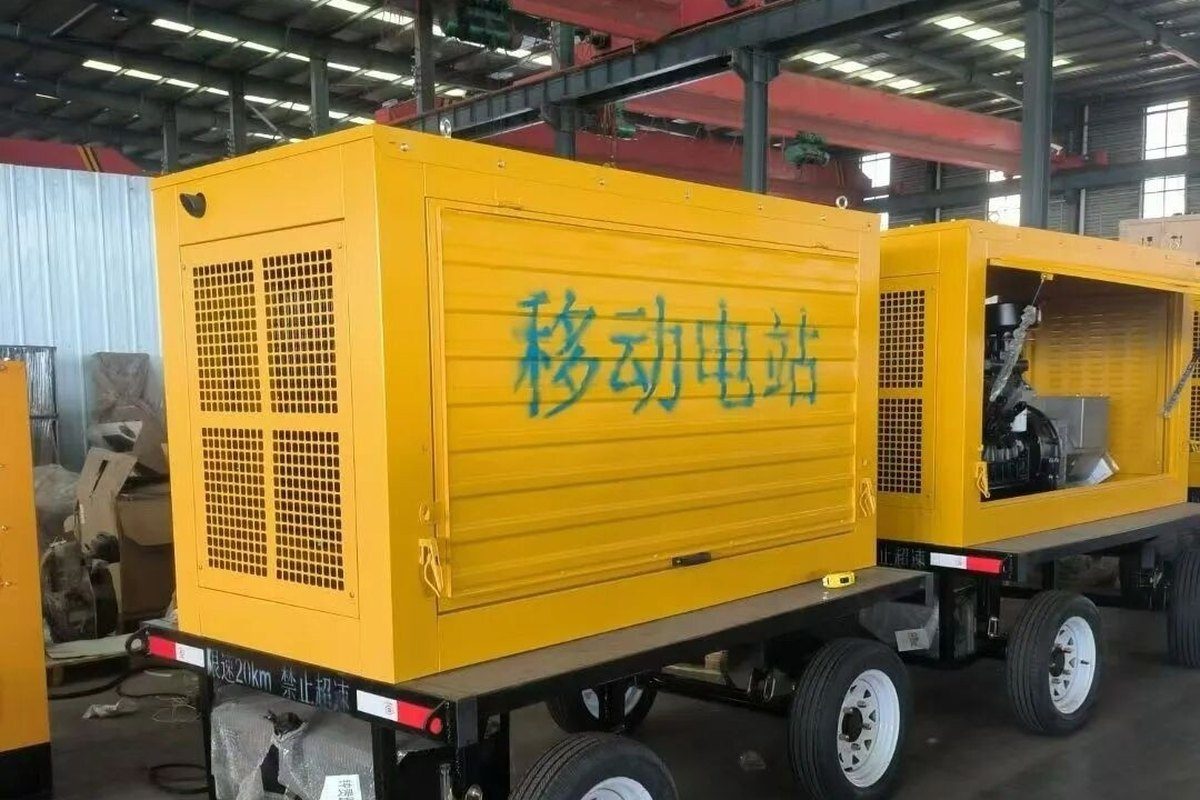
Yellow plate, B2 licence, city bans
Up to 4.5 t GVW a unit can squeeze onto a light truck with a car licence. Above that, everything changes:
- Licence: a heavy goods vehicle needs B2 or above. Many operators only hold a car licence — the unit arrives and nobody can drive it.
- Access: most cities restrict heavy trucks during the day. Emergency vehicles can obtain a permit, but it takes paperwork and a registered operating entity.
- Inspection: private (non-commercial) registration is simpler; commercial registration raises both cost and inspection frequency.
If the unit works inside a plant and only occasionally uses public roads, do the arithmetic before derating the set to stay under 4.5 t: a second B2 driver often costs more than the permit route. And if it never leaves private ground, a towed unit avoids licence and access rules completely.
Rating, mass and chassis
| Rating | Silenced set | 8 h fuel | Unit estimate | Chassis | Body length |
|---|---|---|---|---|---|
| 200 kW | 3.3–3.8 t | 330 L | ~4.6 t | 6 t medium / 4×2 heavy | 5.2–6.2 m |
| 250 kW | 3.9–4.4 t | 410 L | ~5.4 t | 4×2 heavy (16 t) | 6.2 m |
| 300 kW | 4.4–5.0 t | 490 L | ~6.1 t | 4×2 / 6×4 heavy | 6.8–7.6 m |
| 400 kW | 5.4–6.2 t | 660 L | ~7.8 t | 6×4 three-axle (25 t) | 8.6 m |
| 500 kW | 6.4–7.3 t | 820 L | ~9.2 t | 6×4 three-axle (25 t) | 9.6 m |
Body length is limited by wheelbase. A 9.6 m body needs a long wheelbase, which means a large turning circle — and that unit will not get into an old-city street or a narrow plant road. Measure the access route before fixing the body length. We have seen units delivered that could not reach the site they were bought for.
One 500 kW set, or 2×250 kW?
| Single 500 kW | 2×250 kW paralleled | |
|---|---|---|
| Failure behaviour | Single point — total loss | Half capacity remains |
| Low-load operation | Poor: wet stacking below 40% load | Run one set only, better fuel figures |
| Complexity | One panel, one set, anyone can operate | Synch panel, protection, commissioning skill |
| Cost | — | +8–15% (panel, sync, commissioning) |
| Choose when | Stable load, competent operator, no redundancy needed | Data centre, hospital, events where a stop is unacceptable |
Three questions settle it: would a stop cause injury or major financial loss? Is day-to-day load below 40%? Is there anyone on site who can commission a synchronising system? If the answers are no / no / no, buy the single set.
100 m of reel: what it actually costs
| Rating | Full-load current | Cross-section | Copper mass / 100 m | Volt drop / 100 m |
|---|---|---|---|---|
| 200 kW | ~361 A | 2×95 mm² | ~340 kg | ~1.8% |
| 300 kW | ~541 A | 2×150 mm² | ~540 kg | ~2.0% |
| 400 kW | ~722 A | 2×185 mm² | ~660 kg | ~2.1% |
| 500 kW | ~902 A | 3×185 mm² | ~990 kg | ~2.3% |
At 500 kW the cable alone approaches one tonne, plus a 150–200 kg reel. That 1.2 t eats the payload and pulls the centre of gravity rearward. Two alternatives are common in this band: carry only 30–50 m on board and let the site supply the rest, or move up to medium voltage — at 10.5 kV a 500 kW set draws about 31 A, so one 25 mm² cable delivers 100 m at a few tens of kilos. That is exactly why MV starts around 800 kW, and why it is worth considering already at 500 kW.
Outriggers and ground bearing pressure
A 500 kW unit is about 9.2 t. On four points that is roughly 2.3 t per leg — and with the centre of gravity aft, the two rear legs may carry over 3 t each.
- Pad area: a standard Ø300 mm pad is about 700 cm², so 3 t per leg gives roughly 4.3 kg/cm² — enough to sink into asphalt on a summer afternoon.
- Plates: a 600×600 mm steel plate brings it down to about 0.8 kg/cm²; soft or backfilled ground needs 800×800 mm.
- Spread: transverse spread about 1.2× body width. Extending too far beyond the rear overhang twists the longitudinal beams and eventually cracks them.
- Levelling: four independent legs cost more but level far more easily than two legs plus mechanical props. Above 3° of slope you must level — lubrication and fuel pickup both suffer otherwise.
Roof slabs and basements need a separate calculation. Slab live load is typically 2–5 kN/m² (200–500 kg/m²); a 9 t unit on 20 m² is already 450 kg/m² before the point loads at the feet. In that situation the answer is usually a containerised set craned into position, not a vehicle.
Price and lead time
| Configuration | Indicative FOB China | Lead time | Typical duty |
|---|---|---|---|
| 200–250 kW truck-mounted | USD 62,000–80,000 | 50–60 days | Distribution maintenance, large sites |
| 300–350 kW truck-mounted | USD 80,000–108,000 | 55–65 days | Substation support, regional standby |
| 400–500 kW three-axle | USD 108,000–152,000 | 60–75 days | City standby, major events, rail |
| 2×250 kW paralleled (500 kW) | USD 132,000–173,000 | 70–85 days | Data centre, hospital, no-stop duty |
The cost mix shifts here: the set drops to 50–60%, body and conversion rise to 20–25%, switchgear and reel 15–20%, chassis 10–15%. In this band reel length and whether a synchronising panel is included will move the total by more than the engine brand will.
Indicative FOB China references, excluding freight, duties, taxes and registration. Export quotes FOB / CFR / CIF against a named port.
Questions buyers actually ask
Why is a 300 kW unit a yellow-plate truck?
Any goods vehicle above 4.5 t GVW is yellow-plate: B2 licence, daytime city restrictions, different inspection regime. To stay on a blue plate the set must be 150 kW or below — or use a towed unit that is not road-registered.
Single 500 kW or 2×250 kW — what is the cost difference?
Two sets cost 8–15% more, mainly the synchronising panel, protection and commissioning. But running one set at low load saves fuel, and if annual running exceeds about 500 hours the difference usually pays back within two to three years.
Is the volt drop acceptable on a 100 m reel?
At 500 kW with 3×185 mm² and 100 m it is about 2.3%, inside the 5% limit. Coiled cable cools poorly, so derate current by 0.85 and take the next cross-section up for safety.
Can a 400 kW unit stand on a roof slab?
Not recommended. At about 7.8 t over 20 m² it imposes roughly 390 kg/m², close to typical slab live-load limits, and the outrigger point loads are worse. Use a containerised set instead.
How is outrigger ground pressure calculated?
Divide unit mass by the number of legs, adjusted for centre of gravity. A 9.2 t unit on four legs is about 2.3 t per leg; a Ø300 mm pad gives about 4.3 kg/cm², so a 600×600 mm plate is needed to reach about 0.8 kg/cm².
Why is the lead time 75 days?
Set 25–35 days, heavy chassis 20–30 days, body and conversion 25–35 days — in series that exceeds 70 days. A stock approved model or a towed unit (no chassis, no approval) can bring it down to 40–50 days.
Tell us the rating, the site and whether it must be road-registered
Send the load list, the ground conditions (hard standing, roof slab, plant yard) and whether the unit uses public roads. You get a chassis, body length, reel length and outrigger proposal — with the body builder's scope stated separately.
Related: Mobile power units 20–3000 kW · 20–200 kW pickup & light truck · 800–3000 kW medium voltage · Trailer-mounted stations · Containerised generators · Hospital standby · Data centre · Events · Emergency response